You know they have been called brigades for hundreds of years,but you thought brigade combat team sounded more transformational.
Showing posts with label Brigade. Show all posts
Wednesday, 13 April 2022
Sunday, 23 September 2018
The Light Infantry Division: The Readiness Cycle
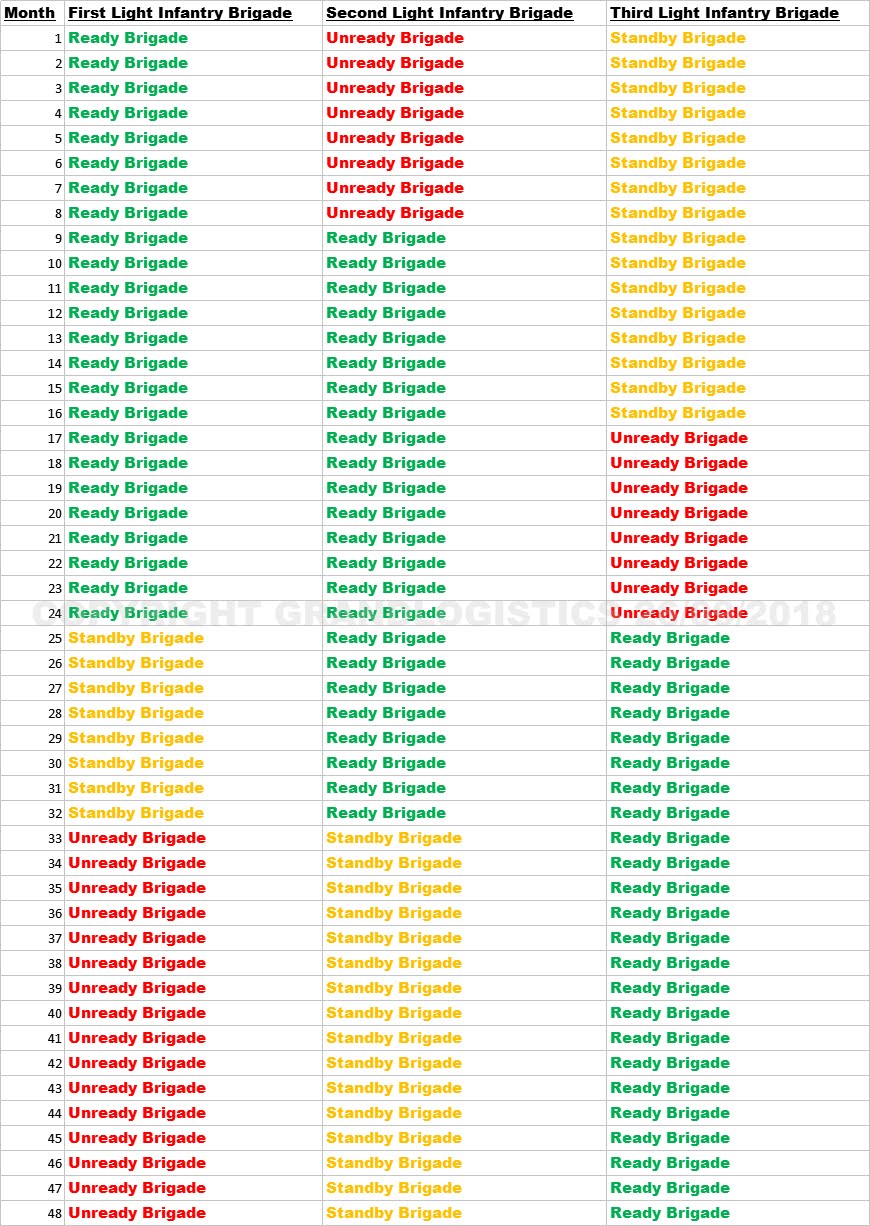
The Light Infantry Division shall follow the same flexible readiness cycle as the Medium Infantry Division,the Heavy Cavalry Division and the divisions of Corps and Army troops (but not the Royal Marines Division which shall follow the Royal Navy readiness cycle) which shall consist of three readiness states and which shall allow one third of the division to be deployed,or ready to be deployed,all of the time or all of the division one third of the time.
Troops in a "Ready" state shall be available for immediate deployment,or deployed,for a period not exceeding sixteen months.
Light Infantry troops in a "Standby" state,shall be available for non routine deployments of up to eight months at ninety days notice,consisting of thirty days notice to muster and thirty days training for the fencibles who relieve the Light Infantry troops from their "Standby Tasks" (ceremonial duties,garrison duties,training support,domestic defence,aid to civil authorities and contingency reserve) followed by thirty days pre deployment training for the relieved Light Infantry troops,with the exception of the contingency reserve which shall be ready for immediate deployment.
Troops in an "Unready" state shall not be available for deployment for sixteen months in a forty eight month period as they shall be resting,re-equipping,retraining or transiting (for the sake of clarity unready periods have been shown as a single block in the following examples,in practice there shall be a short unready period of transiting,decompressing and training between ready and standby periods).
The readiness cycle shall normally start with an unready period during which troops shall be prepared for combat followed by a ready period and ending with a standby period allowing time to decompress under military discipline post deployment but the readiness cycle shall be flexible and shall be adjusted as required within the limits of the Conditions Of Service which shall mandate a maximum of sixteen months of routine operational deployments (and up to eight months of non routine operational deployments) in a forty eight month period.
Photo: Grand Logistics
The Light Infantry Division may keep one of it's three Brigades ready for immediate deployment (or deployed) at all times if the three brigades are one hundred and twenty degrees out of phase in the readiness cycle,as shown above.
This ready brigade may be immediately reinforced by the contingency reserve of the standby brigade or,with ninety days notice,by the full standby brigade for a period of up to eight months.
Photo: Grand Logistics
With a maximum of sixteen months notice,two Light Infantry Brigades may be brought in to the ready state at the same time for a period of sixteen months by means of putting one brigade in to it's standby state before,rather than after it goes in to it's ready state,as demonstrated above by the Second Light Infantry Brigade going in to the standby state in month seventeen so it can go in to the ready state in month thirty three,in phase with the Third Light Infantry Brigade,before reverting to being one hundred and twenty degrees out of phase with the Third Light Infantry Brigade in month forty nine.
Photo: Grand Logistics
For contingencies such as the "Iraq Surge" an irregular readiness cycle shall allow a more rapid increase to the number of brigades in the ready state at the expense of having each brigade ready for up to twenty four months out of forty eight,in the example shown above the Second Light Infantry Brigade shall enter the ready state eight months early in month nine,the fencibles shall be given notice to muster before month fifteen,they shall then take over the First Light Infantry Brigade's standby tasks from month seventeen until month twenty four,allowing the First Light Infantry Brigade to remain in the ready state for an extra eight months when it shall be relieved by the Third Light Infantry Brigade which shall enter the ready state eight months early in month twenty five,two brigades shall then be in the ready state from months nine to thirty two.
Photo: Grand Logistics
If there is sufficient advanced notice of a major operation all three brigades may be brought in to phase for a thirty two month period,allowing them to train and deploy as a full division,all three Light Infantry Brigades are one hundred and twenty degrees out of phase with each other in the first and last sixteen months of the ninety six month period shown above but all are in phase between months thirty three and sixty four,the First Light Infantry Brigade stays in it's normal readiness cycle throughout,the Second Light Infantry Brigade is advanced by one hundred and twenty degrees between the thirty third and eightieth months while the Third Light Infantry Brigade is advanced by two hundred and forty degrees between the seventeenth and sixty-fourth month.
Photo: Grand Logistics
The three close combat divisions,and proportionate elements of the corps and army troops, shall follow the same readiness cycle as the Light Infantry Division,as shown above,a ready brigade from each of the light,medium and heavy divisions would normally be be formed in to a mixed field division to ensure that a range of capabilities is available at all times to deal with any contingency which may arise.
If necessary,the Light Infantry Division,Medium Infantry Division and Heavy Cavalry Division may rotate through the cycle as homogeneous divisions as shown above.
Photo: Cpl. Paul Morrison R.L.C. Crown Copyright
In this manner,the Light Infantry Division may deploy all of it's brigades,a corps may deploy all of it's divisions and an army may be deployed with a full combat corps (consisting of a Light Infantry Division,a Medium Infantry Division,a Heavy Cavalry Division,a Headquarters Division and a Train Division) and a composite corps of army troops,including a Flying Division.
Photo: Cpl. Robert Thaler U.S. Army
Such a force shall be capable of dealing with any opponent the British Army has faced since the Second World War,unlike the single poorly equipped division which British Generals currently plan to deploy with the same force size and budget.
Labels:
Army,
Brigade,
Corps,
Cycle,
Deployment,
Division,
Infantry,
Readiness,
Ready,
Standby,
The Light Infantry Division,
Unready
Monday, 27 September 2010
Future British Army
The British Army currently has 36 "in role" infantry battalions and 9 "in role" armoured regiments.
These units are divided into a mixture of subtypes.
Armoured regiments can be either heavy tank units (effectively armoured horse artillery) or formation reconnaissance units (effectively light cavalry).
Infantry Battalions can be armoured infantry (effectively medium cavalry),mechanised infantry,light role infantry,air assault infantry.
As it takes 5 units to maintain 1 unit deployed it makes sense to have the army's units and formations to be divided into multiples of 5.
These 45 battalions and regiments can be formed into 5 divisions each of 9 infantry battalions or armoured regiments.
A division of 9 battalions can be organised into 2 brigades of 4 battalions with 1 battalion as the divisional reconnaissance unit.
Alternatively the division may have 3 brigades,each of 3 battalions with 1 battalion in each brigade being reconnaissance roled.
In either case the army will have 5 divisions each of 9 battlions and regiments.
An army of 5 divisions should be able to sustain 1 division on operations indefinitely or surge several divisions for short term major warfighting operations.
This supply profile is well matched to the historic demand for British ground forces in wars since 1945.
However,sustaining divisional deployments will require some changes to how overseas non combat postings are dealt with with regard to harmony guidelines.
Currently the British army has role specific brigades such as 16 Air Assault Brigade and 7th armoured Brigade but is lacking in role specific divisions.
This is despite having sufficient assets to maintain such formations.
Consequently the capabilities of the different types of unit within the army cannot be exploited to the full.
A particular situation might best be dealt with by the deployment of a light infantry/air assault division,for example:Kosovo 1999;Afghanistan 2001;Northern Iraq 2003.
The British Army has sufficient light infantry units to deploy such a division but it does not have suitable lightweight divisional support assets as its divisions are effectively general purpose structures.
Similarly there may be situations which require an all heavy armoured division,such as the liberation of Kuwait in 1991,or an all medium division.
This deficiency may be corrected by reorganising units into type specific divisions.
The 9 in role regular Royal Armoured Corps regiments may be formed into a single armoured heavy cavalry division.
A single light air assault division may be formed from 9 light infantry battalions.
The remainder of the infantry may be formed into 3 medium infantry divisions of 9 infantry battalions each.
These divisions may be mixed at all levels as the situation requires but their role specific divisional assets permit the deployment of homogenous formations when needed.
At present divisions are made up of 2 types of armoured regiments (tank and formation reconnaissance) and 4 types of infantry battalion (armoured,mechanised,light role,air assault).
The divisional reorganisation suggested above requires only 3 types of unit:armoured heavy cavalry;medium infantry and light air assault infantry.
With all armoured formation reconnaissance regiments being consolidated within the heavy cavalry division,there is a need to equip them with heavier vehicles more suitable for the higher threat density they will operate in,such as the Warrior.
Within the infantry division the formation reconnaissance role will be taken over by reconnaissance roled infantry battalions equipped with the same vehicles as the division they are supporting.
This completely eliminates the need for any role specific "reconnaissance vehicle",such as the Future Rapid Effects System Specialist Vehicle (F.R.E.S. S.V.).
It also ensures that each type of division has a reconnaissance capability best suited to the level of threat density and terrain density it is most likely to encounter which is not possible with the present homogenous light cavalry formation reconnaissance regiments.
The following new vehicles would be required in the long term to equip the three new division types:
A new heavy cavalry vehicle to replace Warrior and Challenger II in the heavy cavalry division.
A new medium armoured personnel carrier to replace the FV432 Bulldog (Nee Trojan),Scorpion series and others in the medium infantry divisions.
A helicopter portable,front engined 4 and 6 wheeled vehicle to replace Landrover,Pinzgauer,Supacat H.M.T.,Panther and M.A.N. HX within the light infantry division.
In the interim the armoured cavalry regiments in the heavy cavalry division would be equipped with Warrior and Challenger II vehicles pending development of a new heavy cavalry vehicle built around an internal footprint shared with the medium infantry carrier.
The medium infantry battalions in the medium division would be equipped with a mixture of FV432 Bulldog (Nee Trojan),Scorpion series,Mastiff and others pending the arrival of the new medium armoured personnel carrier with a shallow vee hull,non hull penetrating Horstman Hydrogas suspension and capacity for up to 2 pallets or 8 dismounts in addition to a 2 man crew.
The light infantry units in the air assault division would be equipped with Landrover,Pinzgauer and Supacat H.M.T. pending the arrival of new front engined 4 and 6 wheeled helicopter portable vehicles,the latter with the same internal capacity as the medium infantry's armoured personnel carrier.
Labels:
Afghanistan,
Army,
Battalion,
Brigade,
British,
Cavalry,
Division,
FRES,
Future Rapid Effects System,
Infantry,
Reconnaissance,
Regiment
Subscribe to:
Posts (Atom)


+British+Army+Charlie+Company,+1st+Battalion,+5th+Marines.jpg)