Showing posts with label Super Merlin. Show all posts

Tuesday, 2 March 2021

The Three Helicopters: Hector,Hercules And Hermes

  
Merlin Mk 4 helicopters from 845 NAS on RFA Argus
  
  
Further to an earlier piece on rationalising the United Kingdom's naval and military combat helicopter fleet,herein we shall list the only helicopter types which the United Kingdom's armed forces actually need (rather than have or want).
  
Jupiter HT1 Helicopter from the Defence Helicopter Flying School at RAF Shawbury
 
 
The Hector shall be a helicopter of approximately three long tons maximum take off weight used for both naval and military initial helicopter pilot training and for other non combat tasks for which a larger helicopter is unneccessary or impractical such as the Trinity House (lighthouse support) and police force (surveillance) charters.
  
Agusta A109E of 32 The Royal Squadron over Buckingham Palace
  
  
The Hector shall be a modified existing type,such as the elderly AW109 or AW119,or an all new aircraft designed and built in the United Kingdom to stimulate the United Kingdom's economy and secure the future of the United Kingdom's helicopter industry.
 
Helicopter Pilot Training System
 
Picture: Grand Logistics
 
The Hercules shall be a helicopter of approximately six long tons maximum take off weight used for both naval and military combat helicopter pilot training and for other non combat tasks for which a larger helicopter is unneccessary or impractical such as the Waterguard Service (search and rescue) and health service (air ambulance) charters.
  
Agusta Westland AW139M an Italian Air Force HH 139A
 
  
The Hercules shall be a modified existing type,such as the AW139M or AW169M,or an all new aircraft designed and built in the United Kingdom to stimulate the United Kingdom's economy and secure the future of the United Kingdom's helicopter industry,in the interim AW159 Wildcats may perform some of the roles of the Hercules.
  
Merlin Helicopter from 845 Naval Air Squadron conducting damage surveys in Honduras
 
  
The Hermes,or Ultra Merlin,shall be a helicopter of approximately twenty long tons maximum take off weight used for both military and naval combat and for non combat tasks which require a large helicopter such as the Waterguard Service (search and rescue),Home Office (secure transport) and Foreign Office (hospital ship) charters.
  
A Merlin helicopter from 845 Naval Air Squadron with an underslung load
  
  
The Hermes helicopter shall be a Super Merlin helicopter with a new,longer,composite air frame (Super Merlin being a twenty long ton class helicopter which combines the air frame of the Merlin's transport variant with larger rotors,uprated engines and transmission and systems capable of detecting,identifying,tracking and engaging air,surface and submarine targets) designed and built in the United Kingdom to stimulate the United Kingdom's economy and secure the future of the United Kingdom's helicopter industry.
  

Tuesday, 20 March 2018

The Light Infantry Division: The Mule

 
The Mule shall be a family of front engined,four and six wheeled,all wheel drive,unprotected vehicles available in a variety of configurations to fulfil a wide variety of tasks.
 
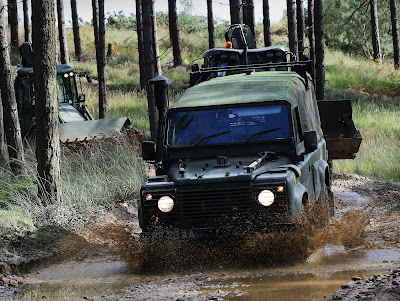
The Land Rover Discovery 4 based Supacat LRV 400 Mk 2 on the 16th of September 2015
 
 
The four wheeled base vehicle shall have a gross weight of four long tons,a gross payload (including the weight of the driver) of over four thousand pounds and an internal volume identical to that of the Pony,Matilda and Charger vehicles.
 
The Supacat LRV 600 concept shown at DVD 2016 on the 7th of September 2016
 
 
The six wheeled base vehicle shall have a gross weight of six long tons,a gross payload of over fifty-two hundred pounds and an internal volume identical to that of the Pony,Matilda and Charger vehicles.
 
 
Most Mules shall be neither armed nor armoured but a Three Eighths Inch Machine Gun and ballistic protection up to STANAG 4569 Levels 2,2a and 2b may be added in lieu of payload when required.
 
A Medical Emergency Response Team rushes an Afghan casualty from a helicopter to an ambulance at Lashkar Gar Helmand Afghanistan on the 19th of February 2009
 
 
The Mule shall generally be used as a more economical substitute for the Pony in benign environments such as driving schools,exercise areas,firing ranges,air fields,depots and bases.
 
Marine Corps aircrew load a High Mobility Multipurpose Wheeled Vehicle on a CH53K King Stallion at Sikorskys Flight Center in West Palm Beach Florida in October 2016
 
The Mule shall not be routinely issued to any field unit,but shall be used in combat only when size or weight constraints preclude the use of the larger and heavier Pony. 
 
The General Dynamics Flyer 72
 
A ten man Light Infantry section equipped with a Mule shall weigh four long tons,half as much as a section equipped with a Pony.
 
A Challenger 2 Main Battle Tank and a Chinook Helicopter on the Salisbury Plain Training Area on the 7th of March 2014
 
 
A Super Merlin or Hermes helicopter shall be able to lift one section equipped with a Pony,two sections equipped with Mules or a full platoon equipped with a pair of Oxen.
 
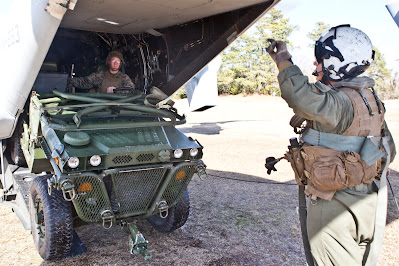
Corporal Saul Ochoa guides Sergeant Trevor R Shepherd driving a M1161 Growler on to a MV22B Osprey at Camp Lejeune North Carolina on the 3rd of February 2015
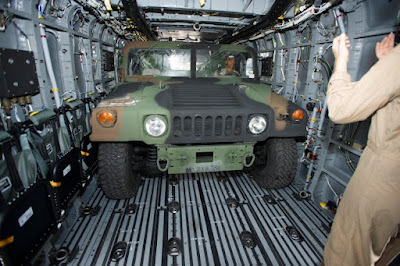
A Super Merlin or Hermes helicopter shall be able to carry a Pony as an external load but shall be able to carry a Mule as an internal load.
 
A 40 Squadron Royal New Zealand Air Force C130 Hercules being loaded with land rover vehicles during Exercise Skytrain
 
A Centaurus aircraft carrying eight Light Infantry sections rigged for airdrop shall be able to carry about thirty-two long tons of additional fuel if they are equipped with Mules rather than Ponys,allowing a significant increase in airdrop radius.


A Centaurus aircraft shall be able to airdrop sixteen Mules using the Dual Row Airdrop System or air land twenty-four.


The Mule shall be able to exploit narrower roads and weaker bridges than the Pony.
 
 
The Mule may be regarded as the spiritual successor to the Land Rover Defender based Truck Utility Medium.
 
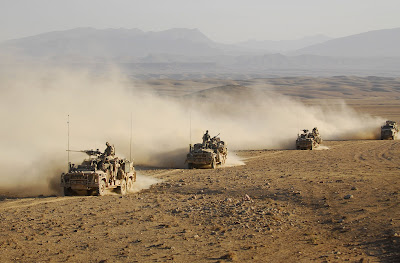
The Wildcat Defence Light Strike Vehicle 320
 
The Mule shall have an external space frame chassis,similar to that of the Ox,inside which a variety of inverted trapezoidal bodies may be bolted and on to which accessories may be fitted,it shall be powered by two and three cylinder variants of the engine used by the Ox.
 
OVIK-CROSSWAY CENTAUR heavy duty chassis options
 
Picture: Unknown photographer,OVIK-CROSSWAY photograph
 
British companies such as Ricardo,Ineos,OVIK-CROSSWAY,HORIBA-MIRA,Wildcat and Supacat have the ability to design and manufacture the Mule.
 
 
 (The Field Car renamed Mule,the Light Protected Truck renamed Pony,dead links replaced,new picture attributions and links added and text and pictures edited on the Twenty-second of January,Twenty Twenty-two)
 

Wednesday, 13 October 2010

Super Merlin


The frontline British military helicopter fleet is currently highly fragmented.

Only as a result of difficult financial circumstances is this situation likely to change.

The Ministry of Defence can no longer afford to operate a multiplicity of types procured in small quantities at high cost.

Many of the older types are likely to be withdrawn without replacement.

The remaining types are likely to consist primarily of 4 newer helicopters which are currently in service or about to enter service.

These are the Apache,Wildcat,Chinook and Merlin.


The Wildcat and Apache fulfill the "find" and "attack" niche roles and consequently make up a minority of the helicopter fleet.

In future these roles may be taken over by other platforms due to technological developments.

It is unfortunate that army aviation is being pigeonholed into these roles.

These helicopters will not be discussed further here but more information on the Wildcat can be found in an earlier post.


The Chinook performs the medium/heavy "lift" role.

This involves transporting men,equipment and supplies.

The helicopter's "lift" role is essential to warfighting in low threat density/high terrain density environments.

The "lift" role can only be performed by helicopters and thus is likely to be the main role for military rotorcraft in future.


The Boeing Chinook is a particularly fast and efficient weight lifter.

It is far more expensive than a British Merlin but also far cheaper than the Sikorsky CH53K.

The internal dimensions of the Chinook are large enough to accommodate light vehicles used by British forces.


However,the Chinook has a number of negative points.

Although it's rotor is a similar diameter to that of the Merlin,it's twin rotor configuration gives it a much larger "rotorprint".

As the Chinook has wheels at all four corners of the fuselage,it also has a much larger "wheelprint" than the tricycle undercarriage Merlin.

This wheel arrangement also precludes parking the Chinook with it's tail protruding over the edge of a ship's flightdeck to save space.

The great and uniform width of the Chinook,due to it's sponson mounted fuel tanks,precludes densely packed parking.

The Chinook is not fully marinised and lacks features such as powered rotor folding,strong rotor brakes and negative lift which are important for operating on ships.


These problems do not preclude the use of the Chinook on board ships.

They do however preclude the efficient use of the Chinook on board ships.

Having even one large helicopter parked on deck with rotors spread has a negative impact on flightdeck operations.

As the United Kingdom has a requirement to deploy air mobile forces by ship,this is a major problem.


The Merlin can perform three primary roles:naval warfare;"lift" (transport) and search and rescue.


Despite the Merlin being a multirole helicopter,the naval warfare Merlin in British service is a specialised anti-submarine helicopter and the "lift" role Merlin of the Royal Air Force is not marinised.

Other countries operate multi-role naval and marinised "lift" variants of the Merlin.

A multirole Merlin could perform all of the Royal Navy's naval warfare tasks,eliminating the need for a naval Wildcat.


In the "lift" role,the Merlin is capable of most tasks but is limited in terms of vehicular lift.

The Merlin's fuselage crossection is slightly too small for vehicles like the Supacat High Mobility Transport (H.M.T.) series.

This is unfortunate as the width and height are only a matter of inches less than that which those vehicles would require for internal carriage.

It would not be a major technical challenge to build a larger fuselage but it would be challenging financially.

For the forseeable future then,Merlin is limited to external carriage of many light vehicles.


Unfortunately the weight lifting capability of the Merlin is less than the 7,500 kg gross weight of the Supacat H.M.T. and similar vehicles.


Merlin's useful load is 6 tonnes,more than the 5,500 kg kerb weight of the Supacat H.M.T.400 Jackal.

But that leaves little margin for fuel.

This problem can be easily resolved.

The Merlin has considerable growth potential.

Uprated engines and transmissions have already been flown on the Merlin and could easily be incorporated into new build helicopters.


With the B.E.R.P. IV rotors a Merlin has already flown at significantly increased weights:


"First flight on the dedicated trials aircraft (ZJ117),which is equipped with RTM322-02/8 engines rated at 2000hp,took place on January 12th 2007.


Trials flying concluded on 9th November 2007,which included an additional programme of flying in support of the UOR clearance. 


During that time the maximum speed demonstrated was 198 knots TAS,and the aircraft operated comfortably at a take-off weight of 16500kg (compared with 15600kg current AW101 maximum mass and 14600kg as the initial design max gross weight for Merlin Mk.3)."


The Rolls Royce RTM 322 has growth potential to 3,300 shp,well beyond the 2,300 shp of current British Merlins.

A minimum modification new build "Super Merlin" H.C. Mk.4,fully marinised with uprated engines,transmission and cargo hook,would be very well suited to British lift requirements on land and sea.


At present the only "lift" roled Merlins in British service are the Royal Air Force H.C.3/3a fleet.

It is currently intended that these helicopters be transfered to the Royal Navy for use in support of the Royal Marines.

However,despite being based on a naval helicopter design,these helicopters lack folding rotors and tails.

Making these helicopters suitable for maritime use will entail significant time and expense.

However,there is an alternative.


At present there is a requirement for new helicopters for use in the search and rescue role both by the armed forces and the Coast Guard.

It is currently intended that newbuild helicopters be purchased for the search and rescue role.

These helicopters may be civilian types.

Pilots trained to operate civilian helicopters will not be able to operate military helicopter types.

There is no benefit to military involvement in search and rescue if the helicopters used are not military types.

There is a justification for military involvement in search and rescue if the helicopters used for that purpose are the same helicopters the military uses in combat.


The Merlin H.C.3/3a helicopters do not have tail and rotor folding which they would require if they are to be transferred to the amphibious lift role.

However,a search and rescue helicopter does not require tail and rotor folding.

The Merlin H.C.3/3a could be converted to the search and rescue role as the Merlin H.A.R.3/3a.

This would free up funds to purchase new build fully marinised amphibious lift "Super Merlin" H.C.4s with uprated engines,transmissions,cargo hook and folding rotors and tails.