Showing posts with label Assistance Class. Show all posts

Wednesday, 26 July 2023

The Cold War

 
HMS Mounts Bay pushes through pack ice towards the cruiser HMS Ceylon who is waiting to transfer ammunition and provisions off the west coast of Korea in 1952
 
 
The Royal Navy has been operating in cold climates for hundreds of years and most vessels in An Independent Navy For An Independent Nation shall operate throughout the United Kingdom,the British Overseas Territories and the Crown Dependencies (except the British Antarctic Territory) and shall be built to Lloyds Register notation Winterisation H,M,C to withstand extremes of temperature which they are likely to encounter in areas ranging from the Shetland Islands down to South Georgia,vessels expected to operate in the low Arctic seas from Canada to Finland shall be built to Lloyds Register notation Winterisation H,M,B and the Assistance class icebreaking tugs which shall operate in the high Arctic ice pack and around Antarctica shall be built to Lloyds Register notation Winterisation H,M,A.
 

Saturday, 24 June 2023

An Independent Navy For An Independent Nation: Remember The Titan

 
The OceanGate Titan submersible
 
 
Following the recent search for the submersible Titan which went missing whilst on a dive to the wreck of the Titanic,herein we shall discuss how An Independent Navy For An Independent Nation could contribute to such an operation.
 
A Republic of Singapore Air Force G550CAEW takes off in Darwin in Australia during Exercise Pitch Black in 2014
 
 
Whether launched from the United Kingdom,Bermuda or an Africa class flying ship,with an endurance of twelve hours at five hundred knots a Perseus aircraft (at least forty of which could have been paid for with the thousands of millions of pounds spent on Nimrod,Sentinel,Reaper,Airseeker,Crowsnest,Poseidon,Wedgetail,Protector and Envoy) could quickly reach the search area and conduct a surface search with it's active and passive multispectral sensors and deploy a pattern of sonobuoys to detect noises from the submersible.
 
The Astute class submarine Ambush retuning to Faslane on the 15th of July 2013
 
 
Beneath the waves at least one of the six Cachalot class and two Defence class submarines (which could have been built with the money spent on seven Astutes) could be in the search area within days,both having the ability to listen for sounds from the submersible and the latter also having the ability to manipulate items on the sea bed.
 
His Majestys Type 23M frigate Cornwall of the Royal Duke class
 
 
On the surface several of the twenty-four Duke,Royal Duke and Falkland class frigates (which could have been built for far less than the cost of six Daring class air defence destroyers,five River class patrol vessels,refits for Type 23 submarine defence frigates,repairs for Type 45 destroyers,eight Type 26 submarine defence frigates,five Type 31 point defence "frigates" and Type 32 mystery frigates) would likely be within a few days sailing of the search area with hull mounted and towed array sonars and Merlin or Hermes helicopters which could be helpful in search operations.
 
The Anatomy Of A Hydrographing Sloop
 
 
At least one of the Hecate class hydrographing sloops is likely to be in the North Atlantic area with it's hull mounted and towed sonars being able to locate items on the sea bed and its tethered submersible being able to investigate and manipulate them.
 
The Australian Research and Supply Vessel Nuyina using a Dynamic Positioning System to manoeuvre
 
 
Two of the four Assistance class icebreaking tugs shall routinely carry a submarine rescue party to support underwater warfare with the Northern Division,whilst the other two shall routinely carry a ship repair party to support vessels on more distant stations,but due to their slow speed it is unlikely that they could cross the Atlantic quickly enough to be of any use.
 
The ALP Maritime Services Striker class tugs Keeper and Sweeper
 
 
However,His Majesty's Rescuing Tug Ranger on station at Bermuda shall be within about a day's sailing time of the Titanic wreck site and her heave compensated crane shall be able to lift the Titan but although designed to accommodate tethered submersibles,a salvage party and a submarine rescue party she shall not routinely carry them and they must be flown out to Bermuda before departure,a flight of around six hours for an aircraft such as the Centaurus.
 

Tuesday, 13 December 2022

The Iceman Cometh

 
Lieutenant General Richard Nugee the Non Executive Director for Climate Change and Sustainability at the Ministry of Defence speaking on the 9th of October 2017
 
 
Retired Lieutenant General Richard Nugee,the Non-Executive Director for Climate Change and Sustainability at the United Kingdom's Ministry of Defence,has suggested that the Royal Navy should harden the hulls of some of it's warships to facilitate operations in "disruptive ice".
  
The Anatomy Of A Mining Sloop
 
 
He should be heartened to know that,despite the impacts on other aspects of performance (which are not all negative),all major warships in An Independent Navy For An Independent Nation shall be built to Lloyds Register Ice Class 1C,not because of the nice weather we have been having but because the Royal Navy has been sailing in icy waters for hundreds of years.
 
The tugs Indulgent Suzanne Christina and Forceful escorting Her Majestys Ship Queen Elizabeth as she leaves Portsmouth to conduct trials with Lightning aircraft on the 24th of January 2020
 
 
The Royal Naval Harbour Service's Able class berthing tugs shall also be built to Lloyds Ice Class 1C (and to Maritime and Coastguard Agency Workboat Code/Lloyds Register Grey Boat Code Category 2 and Fire Fighting Ship 1) for those rare occasions on which the Royal Dockyards are frozen over by global warming.
 
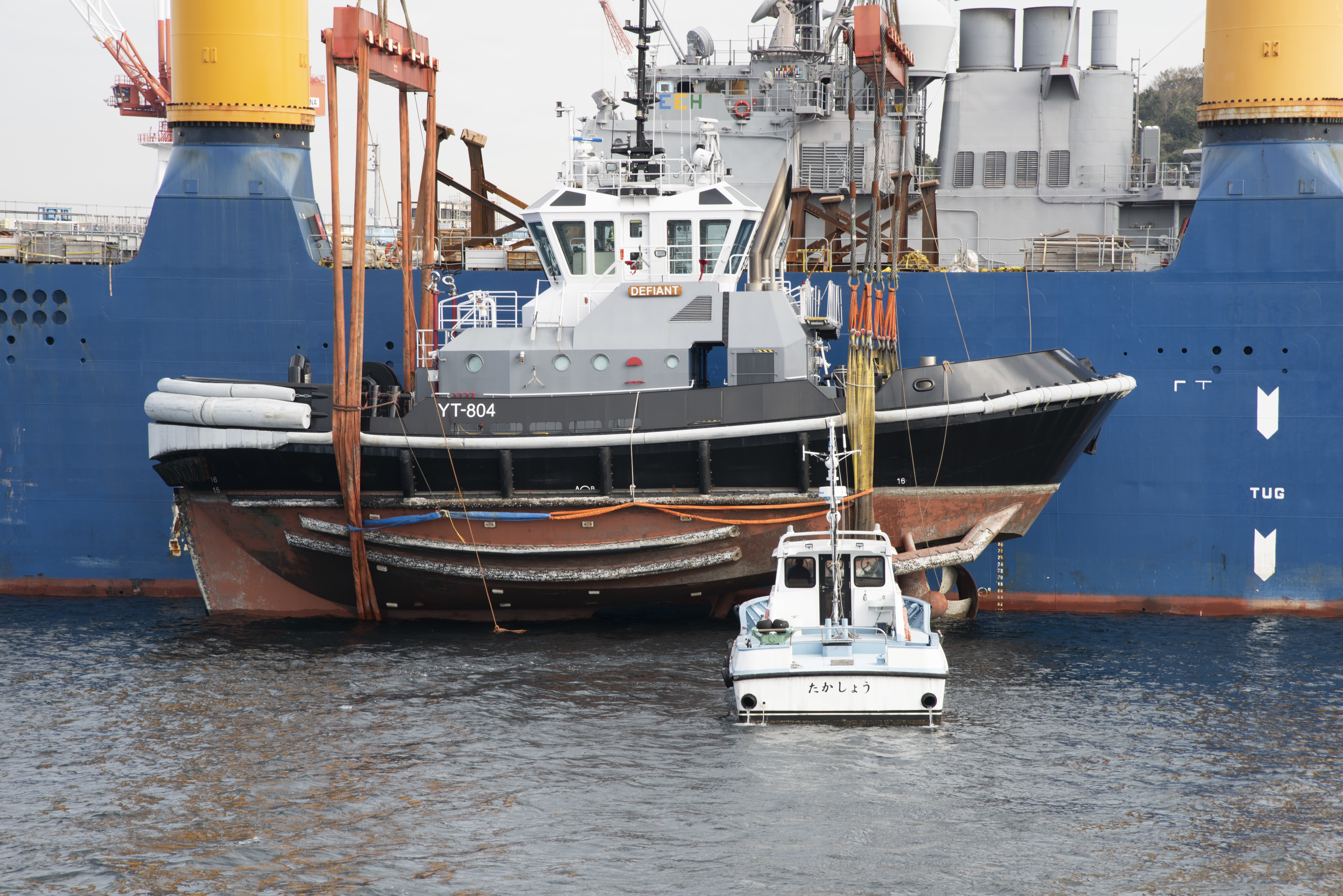
The Military Sealift Command Heavy Lift Vessel Ocean Jazz dropping the Valiant class harbor tug YT804 Defiant in water near Fleet Activities Yokosuka Japan on the 9th of December 2019
 
 
The Royal Naval Harbour Service's Aidful class escorting tugs shall be built to Lloyds Ice Class 1B (and to Maritime and Coastguard Agency Workboat Code/Lloyds Register Grey Boat Code Category 1 and Fire Fighting Ship 2) for use in areas such as the Baltic Sea.
 
The Falmouth based Coastguard tug Anglian Princess being boarded by teams from Fleet Protection Group Royal Marines Scotland and Her Majestys Ship Monmouth off the Devon coast on the 6th of February 2011
 
 
The Royal Naval Harbour Service's Racer class rescuing tugs shall be built to Lloyds Ice Class 1A (and to Fire Fighting Ship 3,including the most powerful fire monitors ever to go to sea) to facilitate operations at extreme latitudes.
 
The Research and Supply Vessel Nuyina breaking fast ice for the first time at the Petersen Bank around the 22nd of January 2022
 
 
The Royal Naval Harbour Service's icebreaking tugs Assistance,Confiance,Diligence and Endurance shall be built to Polar Class 2 (and with the same Fire Fighting Ship 3 system as the Racer class) which,in addition to their moon pools and dynamic positioning systems,shall allow them to perform tasks such as survey,construction,salvage and rescue beneath the Arctic ice pack.